Monitor Engineers

Allow me to help you understand who a monitor engineer is. Also this is an excerpt from my book Essential sound principles.

This type of sound engineer listens to the sound that a band or musician hears on stage. Because the PA is facing the audience, the performer cannot hear anything while on stage. The monitor engineer’s main task is to make sure that the audio that an artist needs to hear is mixed properly, at the right volume levels, and has all of the instruments that the performer needs to execute their job. 

Everything the artist needs to hear on stage is the responsibility of the monitor technician. They mix from the side of the stage, allowing them to make quick adjustments for the band. 

The majority of a monitor engineer’s day is spent solving problems. In an ideal scenario, they would arrive at a venue with all of the necessary equipment, be able to connect all of the mics to each instrument without difficulty, and all of the radio frequencies of the microphones would be functional. 

They go through everything and do a line check for the instruments and wireless packs. They spend the rest of their time installing various redundancy measures to assure a problem-free show when everything is verified to be working. They clean the artists’ in-ear monitoring systems, hand over all of the equipment, and prepare for the event. 

A tip for Monitoring Engineers, You have to be well versed with audio frequencies. In the moments when there is an annoying frequency that causes feedback, you are responsible for making sure that frequency disappears within 5 seconds. 

For more information buy the book Essential Sound Principles by Edison Muhwezi
Audio Engineers

Allow me to help you understand who a sound / audio engineer is. Also this is an excerpt from my book Essential sound principles

A sound engineer is a skilled expert who works within the process of sound recording, mixing, and reproduction. 

A sound engineer differs from a producer, writer, or performer in that he or she is completely responsible for the technical and mechanical components of music and sound production. Let’s have a look at what audio engineering is and what it takes to work in the field of audio/sound engineering. 

To begin with, the titles audio engineers and sound engineers are sometimes used interchangeably. Most people, on the other hand, use the terms “audio engineer” to refer to recording and studio work, and “sound engineer” to refer to live concerts and events. 

In the music industry, a sound engineer is extremely important. If you’ve ever attended a concert, you’ve probably noticed how clear and high-quality the music is. This is because the sound engineer is monitoring and manipulating it behind the scenes. 

Sound engineers don’t always work on the music, but they do mix, reproduce, and control sound’s equalization and electronic effects. Some will design and control the sound at seminars, auditoriums, and other locations where sound projection is required for the audience to hear clearly. When working at music concerts, theatre, sports games, and corporate events, sound engineers must also perform set-ups, sound checks, live sound mixing utilizing a mixing console, and know a sound reinforcement system. 

To provide the finest sound quality for varied settings, sound engineers employ their trained musical hearing and knowledge of acoustics. A sound engineer who is in charge of a large mixing board at a live concert will modify the sound that the crowd hears. This is sometimes referred to as front-of-house sound mixing, although sound engineering encompasses more than that. 

Finally, there are many types of sound engineers (Front of House Engineer, Monitor Engineer, System Engineers, Recording Engineers and Mastering Engineering) that have different tasks and specializations. Keep in mind that, especially at smaller events and concerts, it is not uncommon for one sound person to fill all of these duties. Full engineering staff is usually reserved for well-funded, larger venues or tours.

For more information buy the book Essential Sound Principles by Edison Muhwezi

Exploratory Data Analysis(Part 2)

Welcome back,

In Part 1 we discovered, you’re a commander with a finite amount of resources (i.e. time and data). Exploratory Analysis is akin to dispatching scouts to determine the optimal location for your soldiers to be deployed.


Doing this will make your project so much easier in 3 ways:

  1. You’ll learn useful data cleaning tips (which can make or break your models).
  2. You’ll come up with Feature Engineering concepts (which can take your models from good to great).
  3. You’ll gain a “feel” for the dataset, which will make it easier for you to discuss results and have a bigger effect.

However this process can become long for some and time is a factor to consider while doing this. It is important not to skip this stage but also not to get stuck on it either.

To begin, you’ll need to respond to a few basic questions regarding the dataset:

  • Do I have any other observations?
  • How many features are there?
  • What data types do my features have? Are they digits? Categorical?
  • Do I have a variable to aim for?

After that, you’ll want to show several examples of observations from the dataset to get a “feel” for the values of each feature and to make sure everything is in order.

The goal of exhibiting examples from the collection isn’t to do a thorough study. Rather, it’s to obtain a “feel” for the dataset on a qualitative level.

  • Do you understand the columns?
  • Do those column values make sense?
  • Is the format of the numbers correct?
  • Based on a fast eyeball test, is missing data going to be a major issue?

At this point, you should start making extensive notes about potential improvements. If something doesn’t seem right, such as a possible outlier in one of your features, now is the opportunity to ask the client/key stakeholder or dig a little more.

Categorical Distributions should be plotted.
Histograms are unable to depict categorical features. Bar plots can be used instead.
You’ll want to keep an eye out for sparse classes, which are classes with a small number of observations. A “class,” by the way, is merely a unique value for a categorical feature.

In Conclusion, If you want to get the most out of data, you must first evaluate it properly. And it is not necessary to treat all data sets in the same way.

As Always keep learning.

Exploratory Data Analysis(Part 1)

Exploratory Data Analysis is part of machine learning. It allows a company to perform investigations on data and discover patterns.

With the use of summary statistics and graphical representations, exploratory data analysis refers to the crucial process of doing first investigations on data in order to uncover patterns, spot anomalies, test hypotheses, and check assumptions. This process is usually done by data scientists.

It is a good idea to first understand the data and then strive to extract as many insights as possible. Before getting their hands dirty with data, EDA is all about making sense of it.

Because this skill is the key to avoiding wild goose chases, it is one of the most crucial (though often underestimated) skills.
In data science, there’s a huge problem known as “Tactical Hell.” This is a word used by startups to describe when there are too many approaches / tactics to pick from.

Training a machine learning model is similar to growing a business in many respects. You also have an excessive number of “tactics” to choose from:
Is it necessary to wipe your data more frequently? Collect more information? More features to develop? Do you want to try out some new algorithms?

Going in blind could mean disaster for your entire project because there’s a lot of trial and error involved. So, how do you avoid ending up at a dead end? “Exploratory Analysis” is the answer. (This is just a fancy way of saying “get to know” your data.)
Consider the following scenario: You’re a commander with a finite amount of resources (i.e. time and data). Exploratory Analysis is akin to dispatching scouts to determine the optimal location for your soldiers to be deployed.
Making this decision up front will make the rest of the project go much more smoothly.

In the Next Blog i’ll share a few steps on how this is done. As always keep learning.

Differences between the principles of AI and Traditional Software

Software Engineering has risen over the decades and software development has formed basic principles that everyone can emulate to create a successful software product. However the principles of building AI products and businesses are still being developed and there are key differences in both.

Unclear Technical Practicability

What a standard mobile app or web app can achieve is fairly well recognized. You can probably build it if you can create a good wireframe. However, it’s difficult to determine how accurate an AI system may be in a certain application until you review the data and conduct some experiments. Many technologists, for example, exaggerated the ease with which a safe self-driving automobile might be built. In general, AI businesses pose a larger technical risk than typical software startups since it is more difficult to determine whether a technology idea is realistic in advance.

Product Specification

A wireframe can be used to show how safe a standard web program is, but you can’t build a wireframe to show how safe a self-driving car must be. Specifying operating conditions (also known as the operational design domain) and acceptable error rates under varied conditions is exceedingly difficult. Similarly, writing a spec for a medical diagnosing tool can be difficult, depending on how acceptable various forms of errors are (since not all errors are equally severe). Furthermore, product specifications frequently change as the team learns what is and isn’t physically achievable.

The Data

To create a traditional software product, you might conduct user interviews to ensure that they desire what you’re building, show them a wireframe to ensure that your design fulfills their requirements, and then start developing code. You’ll need to write code to create an AI product, but you’ll also need data to train and test the system. This may not be a difficult task. You might be able to start with a limited amount of data from an initial cohort of consumers for a consumer product. But how can you acquire access to shipping data or medical records for a product aimed at business clients, such as AI to improve shipping or help a hospital manage its medical records? Some AI firms begin by providing consulting services. Although these activities are difficult to scale, they provide access to data that can be used to create a scalable offering.

Maintenance

The boundary criteria — the range of valid inputs d — are usually simple to establish in traditional software. Indeed, traditional software frequently validates the input to ensure that it receives an email address in a field designated to that input, for instance. The boundary conditions for AI systems, on the other hand, are less obvious. How do you detect when the input distribution has varied so much that the system requires maintenance if you’ve trained a system to handle medical records and the input distribution progressively changes (data drift/concept drift)?

Conclusion

These are the key differences between building AI and traditional software and while it is not yet clear how some of these are resolved, a number of companies are finding and creating ways to tackle these challenges in the field of Artificial Intelligence.

Keep Learning.

Skepticism

Many people treat this as a bad word but in my opinion it is not. Think about it. Being skeptic about something means questioning some knowledge.
Now don’t get me wrong i know there are people who take this too far and question everything to the point where they don’t want to understand and just want to argue.

In my opinion being skeptical means asking the right questions. Questions like, Am I intellectually lazy? Neil deGrasse Tyson says skepticism is the path of inquiry to what is true.
Carl Sagan once said extraordinary claims require extraordinary evidence.

You have to question what you are unsure of but also recognise when valid evidence is presented to you to eventually change your mind. A great example would be when you were a child and maybe you questioned why your parents would not allow you to drink as much soda as you wanted and as you actually got older, you realised, after acquiring certain information, the health risks involved in taking such large amounts of sugar.

When the results of something stay consistent, it is known as an objective truth. In this present age of overflowing information, it would be wise to question and find out objective truths of things you are involved in or things you are potentially interested in.

Be a skeptic and keep learning.

The Pinnacle Level

This is a personal opinion from the book The 5 levels of leadership by John C Maxwell specifically level 5 the Pinnacle level.

In the Pinnacle level, people follow you because of who you are and what you represent. These kinds of people seem to bring success with them wherever they go.  You emphasize on building leaders who build other leaders to tackle as many challenges as possible and to extend their influence way beyond their industry or organization. 

You also continue to mentor potential level 5 leaders.

The idea is to leave behind other leaders that can carry the mantle that you leave behind. I imagine a world where I don’t need to be at work but everything is running so well that they don’t even bother calling to ask where I am. I imagine this for me and for the team I lead with. A future where there are so many competent people doing better than we ever could do.

The highest position of leadership is a place not to receive but to give. No matter the position you are in never forget that what got you to where you are won’t get you to the next level. I have to keep learning. I have to be a life long student of leadership.

In the 21 laws of leadership, the law of respect is shown best at this level because people naturally follow leaders stronger than themselves. 

You also practice the law of intuition. Meaning that you evaluate everything with a leadership bias. You experience immediate insight without without rational thought.

At this level you have so much experience and credibility that people listen to your hunches when it comes to timing and that is within the law of timing.

The law of legacy is fulfilled because the goal is to create something that lives on forever way after you are gone.

The discipline of Simplicity

The discipline of simplicity is freedom. It brings joy and balance. It is inward reality. It is difficult in this day and age to practice this discipline because everywhere you turn is overwhelming pressure to trend in something you did not even intend to try. Whether it’s a new dance, new fashion style, new hair cut, there seems to be something new to try or risk being shunned by even your peers. But when we experience inward reality, we are liberated outwardly. The lust for status and position is gone because we no longer need status and position. We must therefore focus and center our lives to seeking His kingdom for in it is simplicity.

Nothing must come before the kingdom of God, including the desire for a simple life-style.
Simplicity itself becomes idolatry when it takes precedence over seeking the kingdom.
Nothing else can be central. The desire to get out of the rat race cannot be central.
Seeking first God’s kingdom and the righteousness, both personal and social, of that kingdom is the only thing that can be central in the Spiritual Discipline of simplicity.

Questions I think About

I do from time to time think about so many things. Some would say I am an occasional day dreamer. I think about the past, the present and the future. I travel to spaces i have never been to. I also travel to a land of questions. These questions are very challenging at times, some would say scary but they do help me evaluate where I am, how far i have i have come and how much more work i need to get done. Here are some of them:

“Who am I really?”

“Why am I here?”

“What am I doing right now?”

“Is it all worth it?”

“If I stopped doing the work I do now, would I be happy?”

“What do I need to learn to improve myself?”

“Is what I am going to learn worth it?”

“Do I want to continue on this path?”

“What is God saying about these things?”

These are some of the questions i keep repeating just to check and see if I am on the right path or if I am deceiving myself. I believe you can deceive everyone else but to deceive yourself is a very slippery slope that is hard to climb back from.

If you’re not doing the things that you love it is your fault.

Remember who you are and grow yourself into the person you know you can become.

I believe in you. I am proud of you.

Always Keep Learning.

Supervised Learning

What is Supervised Learning?

Supervised learning is a machine learning method that maps an input to a desired output. Supervised machine learning algorithms learn by example, like a teacher teaching a class hence the name supervised.

For example if you have say a dataset of 50 pictures of 3 sided figures(triangles) and 4 sided figures(squares), your dataset should include the names of each triangle and square. The supervised machine learning algorithm once trained on this data is then able to figure out the difference between a square and a triangle.
The objective of supervised learning is to predict a correct output for newly presented inputs. In this case if a new image of a square is presented, it should be able to call it a square.

Supervised learning has two categories. These are classification and regression

Classification

A classification algorithm classifies the data into different data points. For example most emails are classified into spam or not spam. A set of parameters are designed into the classification algorithm that allows your actual emails show up in your inbox and the rest in spam. This problem is actually called a binary classification problem.
You can have as many classes as you want depending on the dataset you have access to.

There are a couple of algorithms that can help with classification.

  • Linear classifiers
  • Support Vector Machines
  • Decision Trees
  • K-Nearest Neighbour
  • Random Forest

Regression

Regression algorithms are used mostly for predictive statistics. The goal is to find relationships between dependent and independent variables. This is usually used to predict a continuous value like in sales, income, sports, studies and so on.

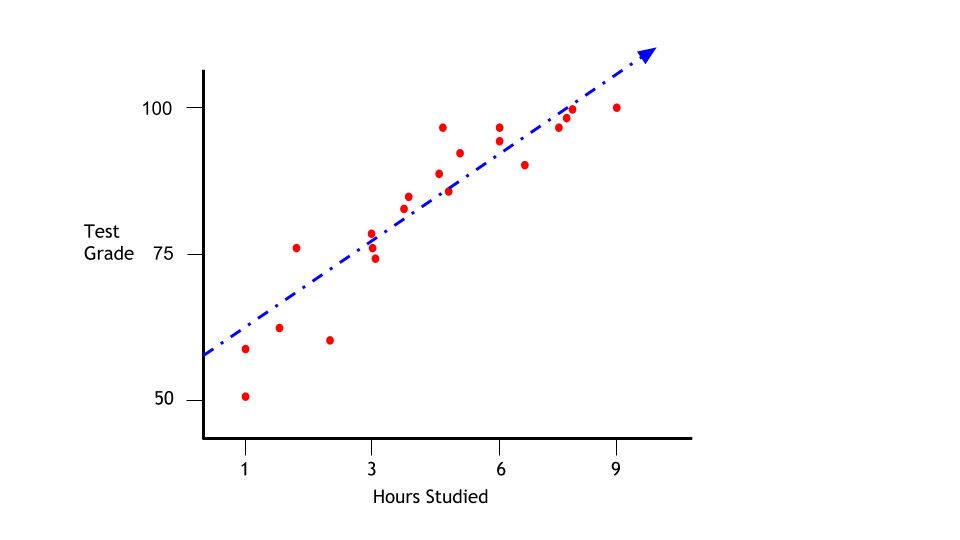
Let’s say we wanted to predict a student’s grade based on how many hours they studied.

This diagram was designed by Aidan Wilson.

From this example we can tell that there is a great relation between the hours being studied and the final test score. The line in blue is called the line of best fit. This shows us how the model would predict a new scenario. If we wanted to know how well a student did after 2 hours of study, the model can tell us the result based on the previous labels it learned from the dataset.

There are three types of algorithms that can help us with the regression problem.

  • Linear regression
  • Logistic regression
  • Polynomial regression

Conclusion

Supervised Learning is usually the introduction to machine learning. It is easy to understand and implement. It is commonly used in many industries and keeps proving to be an excellent tool in use today.

Always Keep Learning